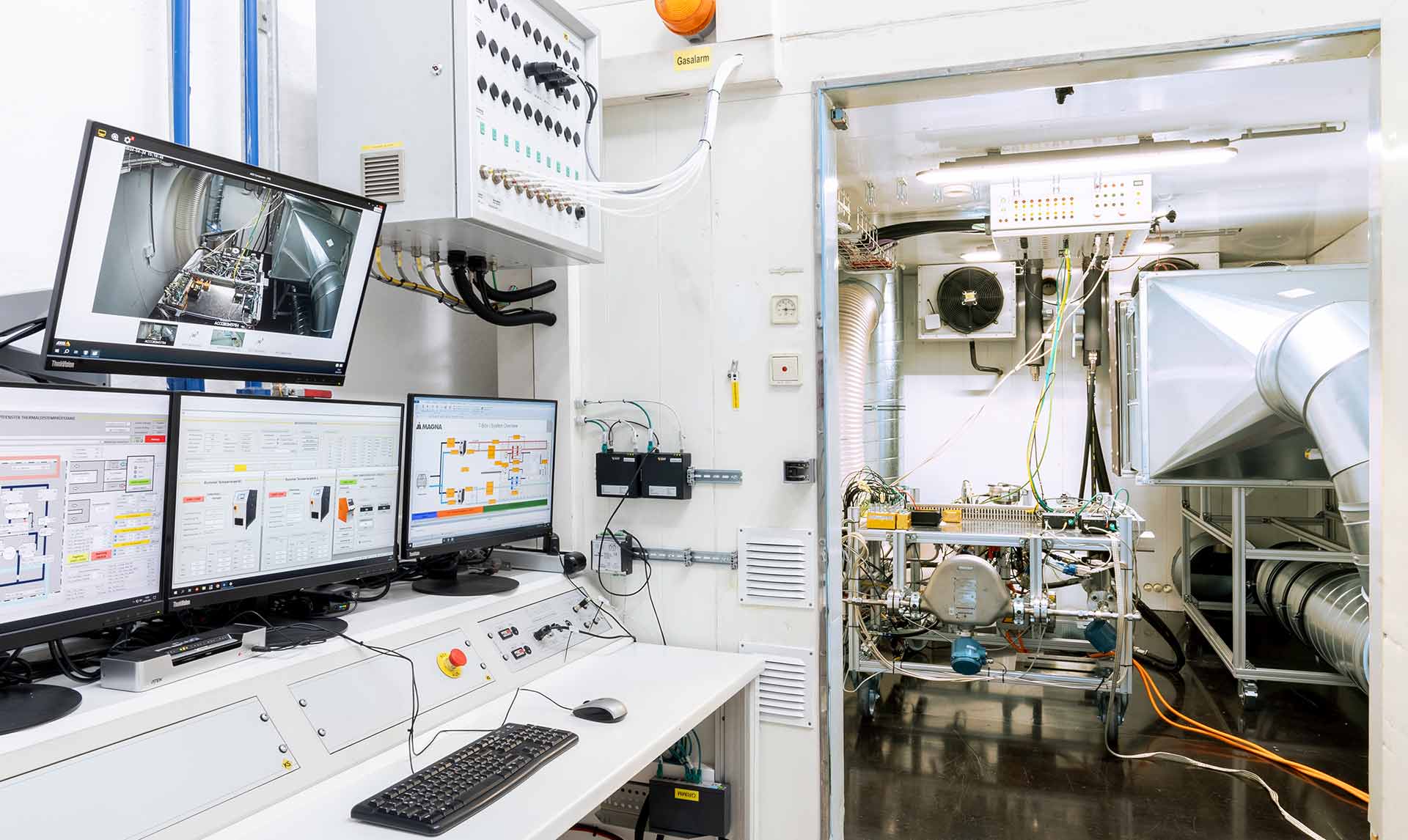
Thermal System Testing
Accelerating Thermal System Development – From Component Characterization to Full System Validation
Our thermal system test bench at Engineering Center Steyr (ECS) provides a controlled environment for validating modern vehicle thermal systems. From component to full system level, we enable precise analysis, optimization and validation under reproducible lab and real-world conditions. Our flexible test setups cover HVAC, refrigerant and coolant systems including the capability to test natural refrigerants such as propane (R290) or CO2 (R744).

“Achieving the right balance between development time, costs and system performance requires a holistic approach to thermal system development. This is exactly where our thermal system test bench delivers significant value for our customers.”
What role does thermal management play in modern vehicles?
Maintain optimal operating conditions
Ensures that all components operate within their required temperature ranges for safe and efficient performance.Support energy efficiency
Reduces energy losses by balancing heating and cooling demands across the entire vehicle system.Enable system performance and stability
Prevents overheating or over-cooling, ensuring consistent functionality of powertrain, battery and auxiliary systems.Contribute to passenger comfort
Regulates cabin climate through efficient HVAC operation under all environmental conditions.Integrate multiple subsystems
Coordinates interactions between refrigerant, coolant and air systems within increasingly complex vehicle architectures.Comprehensive Thermal System Validation
By reproducing all relevant vehicle and environmental boundary conditions on the test bench, thermal systems can be validated, calibrated and optimized independently of the vehicle. This enables efficient system and function development while supporting the safe testing and validation of next-generation refrigerants such as propane (R290) and CO2 (R744).
Testing supports:
- Component and system characterization
- Control strategy development and validation
- Functional and durability testing
- System efficiency investigations
Complete System Testing
Full vehicle-level thermal systems can be analyzed under simulated driving and environmental conditions, enabling holistic optimization and validation.
Testing scope:
- Control strategy validation and holistic efficiency optimization
- Build-up of refrigerant and coolant circuits within a single test setup
- Combined thermal performance and efficiency validation on system level
- Calibration and validation of control strategies under real operating conditions
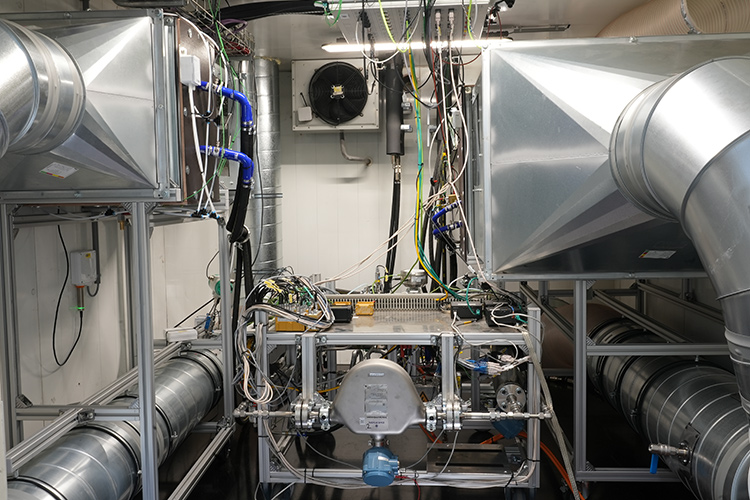
Module Level Testing
Subsystems such as HVAC units, refrigerant loops, and coolant circuits are evaluated for efficiency, control strategies and system interactions.
Testing scope:
- A/C system and heat pump validation
- COP studies and overall efficiency investigations based on SAE standards
- Analysis of subsystem control strategies (e.g. hot gas bypass vs. air heater concepts)
- Analysis and Characterization of Single Components
- Evaluation of defrosting strategies for evaporators and heat pumps
- Assessment and validation of conventional and natural refrigerants (eg. R290 or R744 ) and architectures
- Durability testing on system level
- Oil circulation rate investigation
- Coolant circuit validation
- Hydraulic flow distribution and pressure drop analysis
- Deaeration and expansion tank investigation
- Validation and calibration of HVAC air distribution and control functions
Controlled Test Environment & Capabilities
Our thermal test chambers provide dynamic and reproducible conditions. Advanced measurement systems ensure precise monitoring of temperature, pressure, flow, humidity and refrigerant behavior.
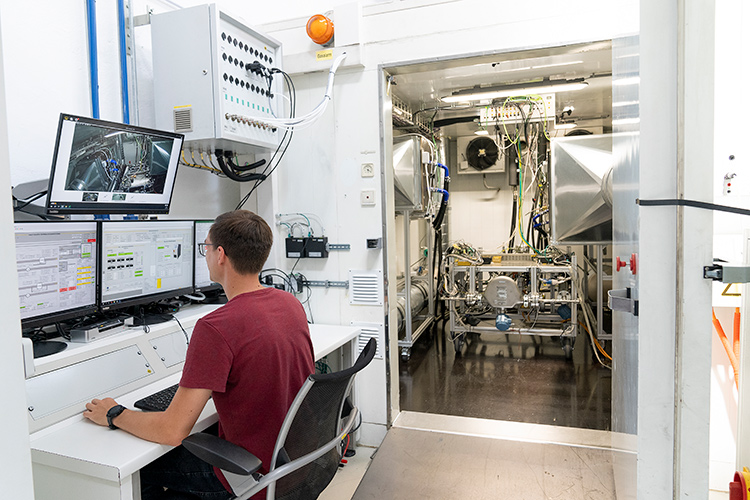
Test Chamber
Ambient
- Temperature -15°C to +50°C
Air flow
- Air flow circuits 2 circuits
- Air flow 1 up to 8000 m3/h
- Air temperature 1 -15 to +50°C
- Air flow 2 up to 800 m3/h
- Air temperature 2 -15°C to +50°C, up to 80% rH
Coolant
- Cooling circuits 4 circuits
- Coolant temperature -20 to +90°C
- Coolant volume flow up to 50 l/min
- Heating performance up to 24 kW
- Cooling performance up to 17 kW
Power Supply
- Voltage up to 800 V
- Power up to 32 kW
Measurement Equipment
- Refrigerant mass flow sensor (Coriolis)
- Coolant volume flow (turbine)
- Oil circulation rate (sound velocity based)
- Air mass flow sensor (HFM)
- Air speed (anemometer, Wilson grid)
- Humidity (capacitive humidity sensor)
- Pressure (strain gauge based)
- Temperature (PT100, NiCr-Ni)
Why is Thermal System Testing essential for modern & efficient vehicle development?
Holistic system understanding
Enables detailed analysis of interactions between HVAC, refrigerant, coolant and vehicle systems to ensure seamless system integration.Faster and more cost-efficient development
Detects issues early, reduces development risks and supports flexible testing from component to full vehicle level, accelerating time to market.Reduction of Prototype Vehicles
Frontloading of system testing increases vehicle integration speed and significantly reduces the number of required prototype vehicles.High comparability of test results
Identical ambient temperatures, load profiles, and drive cycles can be repeated as often as required.Faster Software and Control Development
Vehicle-independent calibration and optimization accelerate software releases through early validation and continuous testing.FAQs - About Thermal System Testing
What systems are included in thermal system testing?
Thermal system testing includes HVAC systems, refrigerant circuits, coolant loops, heat pumps, and complete vehicle thermal management systems.
Is it possible to test natural refrigerants like propane (R290) or CO2 (R744)?
Yes, the test bench is fully capable of testing both conventional refrigerants and next-generation natural refrigerants such as propane (R290) and CO2 (R744).
What is the difference between component and system-level testing?
Component testing focuses on individual parts such as compressors or heat exchangers, while system-level testing evaluates the interaction and performance of the entire thermal system.
How are real-world conditions simulated in the lab?
Environmental chambers control temperature, airflow, humidity, and load conditions to replicate realistic operating scenarios with high reproducibility.
Why is control strategy validation important?
Modern thermal systems are highly software-controlled. Validating control logic ensures optimal efficiency, comfort, and system reliability in all operating conditions.
Thermal Vehicle Testing
Beyond lab testing, we validate thermal systems under real conditions:
- Vehicle thermal and energy management validation
- Cabin HVAC and thermal comfort testing
- Performance and efficiency verification
- Calibration of control strategies
- Testing on chassis dyno, test track and road

