Engine & eDrive Testing
Powertrain Testing - From Combustion Engines to Electrified Drivelines
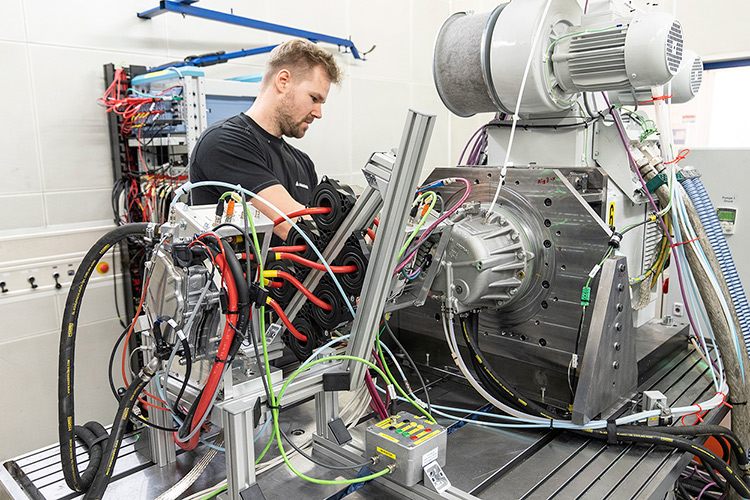
Our engine, eDrive and complete powertrain test benches provide a comprehensive testing environment for the development, validation and benchmarking of modern powertrain systems. From early prototypes to serial production readiness, combustion engines and eDrive components, up to complete eDrive or eAxle systems, are tested under highly controlled and reproducible laboratory conditions.
Flexible configurations, including back‑to‑back setups and extensive air and media conditioning are complemented by a test infrastructure at Engineering Center Steyr that enables precise and repeatable measurements across mechanical, electrical and environmental conditions, ensuring performance, efficiency, durability and compliance for a broad field of applications.

“As powertrains become increasingly complex and electrified, testing must extend beyond individual components. Only reproducible, system‑level test environments provide the transparency needed to understand interactions, assess integration effects and support confident development decisions across different drivetrain concepts.”
Josef Schäffler
Senior Expert, Propulsion Engineering
What types of engine, eDrive system & component testing are required to validate modern powertrain systems?
Stationary testing
Verifies motor behavior at specific speeds, torques, and temperatures under steady conditions.Dynamic & transient load and speed profiles
Evaluates motor response to real‑world driving scenarios.System-level testing of eDrives & eAxle configuration
Assesses combined motor, inverter & transmission performance as an integrated unit.Performance & functional testing
Confirms power output, torque delivery, control functions, and fault responses.Efficiency & loss analysis
Measures electrical and mechanical losses to optimize energy efficiency & thermal behavior.Reproducible laboraty validation from prototype to series development
Ensures consistent, repeatable results across development phases to support industrialization.Combustion Engine Testing for different fields of application
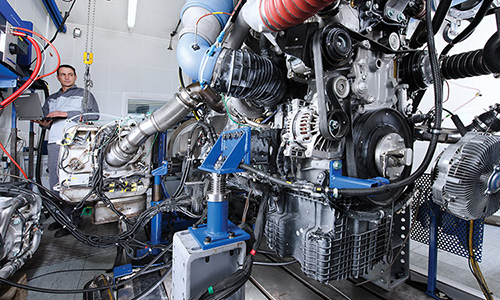
Our engine test benches support the development and validation of diesel and gasoline engines, from early prototype investigations to serial production readiness.
Testing activities cover complete engines, after-treatment systems and drivetrain integration, enabling robust powertrain validation across all development phases.
Engines are coupled to asynchronous dynamometers, allowing precise control of load, speed and transient conditions to replicate real driving behavior as well as customer‑specific cycles. Comprehensive media conditioning for intake and ambient air, coolant, oil and fuel ensures accurate and reproducible operating conditions.
Based on customer demand we have the possibility to use thermal shock devices, external oil supply, inclination test bed or other specific measurement devices to perform tailor made engine tests.
Our high altitude & climate test bench offers engine testing under fully controlled ambient conditions.
Fields of Application
- Passenger cars
- Light & heavy duty trucks
- Non-road applications
- Marine and aerospace engines
Main Development Topics
- Dynamic & steady-state testing
- Functional & durability testing
- Engine and OBD calibration
- Exhaust gas aftertreatment development
- Benchmarking & homologation support
- Friction and efficiency analysis
Technical Specifications
- Compression and spark ignition engines
- Mechanical power up to 600 kW / 3600 Nm
- Electrical power supply 48 V
- HV battery simulators available
Measurable Physical Parameters
- Temperature
- Pressure
- Volume flow
- Current & voltage
- Dynamic fuel consumption
- Engine-out and tailpipe emissions
Emission & Measurement Equipment
- AVL FTIR / IAG FTIR
- AVL Micro Soot Sensor
- AVL Particle Counter
- AVL Opacimeter
- AVL Indicating System
- AVL Fuel Measurement & FlowSonix
- Horiba MEXA systems
- Oil soot analyzers & Smart Sampler
Advanced eDrive System Testing
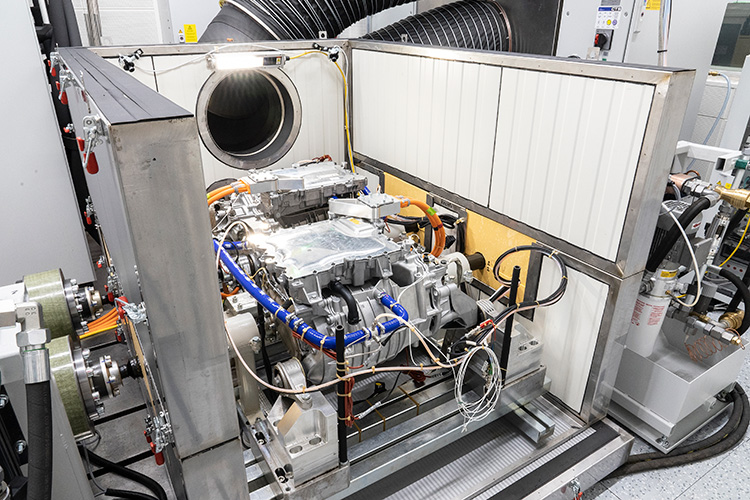
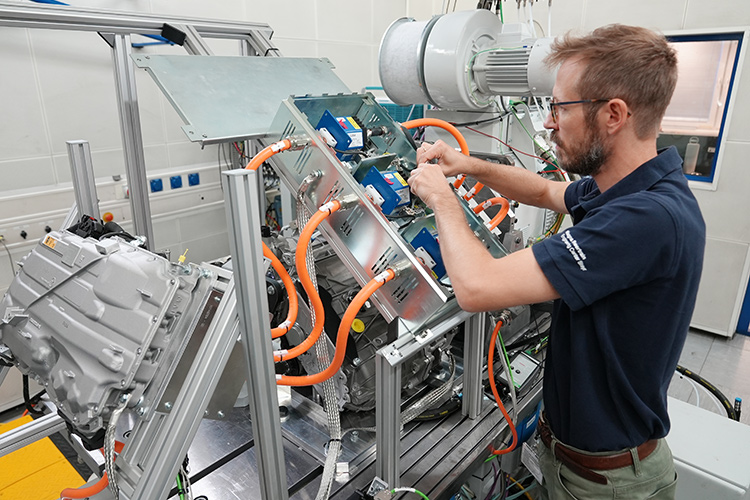
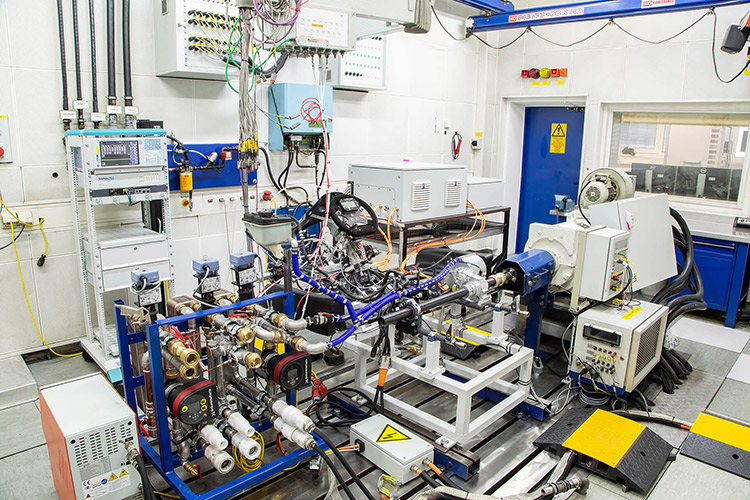
Our eDrive testing portfolio covers the full spectrum from single electric motors to complete eDrive systems.
Devices Under Test (DUT) can be subjected to defined load, speed and environmental conditions that accurately replicate real-world driving as well as laboratory-specific stress scenarios.
Back-to-back (B2B) configurations allow efficient durability testing of two or more eDrive systems simultaneously. Powerful conditioning systems for ambient air and coolant of the DUT, allow temperature ranges from -40°C to +170°C.
Over the past few years, a significant part of the testing area has been transformed into eDrive test benches.
Typical Test Scope
- Component testing (Rotor, stator, inverter)
- System & functional testing (eDrive, eAxle)
- Benchmarking
- Efficiency and loss analysis
- Durability testing (B2B)
- NVH investigations
Test Configurations
- 1M eMotor/eDrive test bench
- 2M eDrive/eAxle test bench
- Back-to-back (B2B) set-ups
- Customer specific set-ups for component testing
Technical Highlights
- Max. speed: < 20,000 rpm
- Mechanical power: up to 529 kW
- HV power supply: up to 1000 V / 1200 A
- Battery simulators up to 1250 V / 1400 A
- Extensive air, water and oil conditioning
Measurement Equipment
- HBM torque flanges
- LEM current transducers
- Yokogawa power analyzers
- RedAnt measurement systems
- Vector/CANoe or ETAS/Inca
How does engine & system-level eDrive testing support powertrain development?
Validation of complete systems rather than single components
Ensures the full drivetrain works correctly as an integrated system, not just in isolation.Analysis of interactions between motors and power electronics
Identifies how subsystem interactions affect performance, efficiency, and reliability.Early identification of integration effects & system limits
Detects constraints, weaknesses and conflicts early in the development phase.Reduction of development risks before vehicle-level testing
Minimizes costly redesigns and failures during later vehicle testing stages.Support for engineering and design decisions
Provides data-driven insights to optimize system architecture and component selection.FAQs - About Engine & eDrive Testing
How are engines and eDrives tested under reproducible laboratory conditions?
Engines and eDrives are tested under reproducible laboratory conditions using highly controlled dynamometer test benches where the device under test (DUT) is securely installed. These systems allow precise control of load, speed, and other operating parameters, enabling both standardized and customer-specific test cycles to be executed reliably. In addition, consistent environmental and media conditioning ensures stable testing conditions, so measurement results remain comparable and repeatable throughout all development phases.
Can electric motors and complete eDrives be tested on the same test bench?
Yes, modular test bench configurations make it possible to test electric motors and complete eDrive systems on a single platform. Individual components such as eMotors and inverters can be tested separately, while full eDrive or eAxle systems can also be integrated as needed. This flexibility allows efficient use of one test infrastructure for a wide range of development tasks.
What are the benefits of back-to-back (B2B) testing for eMotors?
Back-to-back (B2B) testing enables two or more electric motors or eDrives to be tested simultaneously on a single test bench. This approach is particularly effective for durability testing, as it allows energy to be transferred between the machines during operation, significantly reducing overall energy consumption compared to single-motor setups. At the same time, it accelerates the validation of long-term operating behavior under realistic conditions, improving overall testing efficiency.
Why is precise and repeatable measurement essential in engine and eDrive testing?
Precise and repeatable measurement is essential to ensure that results from different test runs can be reliably compared. High-accuracy sensors capture mechanical and electrical parameters such as torque, speed, current, and voltage, often at high measurement frequencies. This creates a robust and consistent data basis for development and validation decisions, while also supporting compliance with global standards and application-specific requirements.

